Getty Villa Or Getty Center: Which One Should You Visit?
Two free Getty museums, twenty miles apart, built for completely different afternoons. A side-by-side comparison of art, setting, parking and how to choose.
Getty Villa Or Getty Center: Which One Should You Visit?
Most visitors with one afternoon should pick the Getty Center, because it holds the larger collection, the bigger campus and the famous hilltop views over the whole Los Angeles basin, and its timed reservation and admission are both free. Choose the Getty Villa instead if you want ancient Greek and Roman art inside a reconstructed Roman country house, a quieter single-building visit and a stop on the coast.
The honest answer is that these are not really competitors. The Getty Center sits on a ridge above Brentwood, a campus of white travertine buildings designed by Richard Meier, reached by a hovertrain that climbs the hill from the arrival plaza. The Getty Villa sits at the mouth of a canyon on Pacific Coast Highway in Pacific Palisades, a single building modeled on the Villa dei Papiri at Herculaneum, with an inner peristyle garden that smells of bay laurel. One is a full day's museum with gardens, a research institute and a painting collection that runs from the Middle Ages to modern photography. The other is a tightly focused study of the ancient Mediterranean, wrapped in a building that is itself the main exhibit.
Both are run by the same trust, both are free to enter, and both require a free timed reservation booked in advance. That shared price tag is why the question comes up constantly in trip planning: if the entry costs nothing either way, the choice becomes about time, energy and what you actually want to look at. This comparison on Los Angeles Museums breaks the decision into art, setting, logistics and cost, so you can match the right Getty to the right day of your itinerary.
If you are already leaning toward the Center, the practical details are covered in depth in how much a Getty Center visit costs, and the question of whether the Getty is really free has its own answer, since the free part has a paid catch that surprises first-time visitors.
What Kind Of Museum Is Each One?
The Getty Center is a broad general-art museum: European paintings, drawings, sculpture, manuscripts, and international photography, spread across multiple pavilions and gardens on a hilltop campus. The Getty Villa is a single-subject museum of ancient Greek, Roman and Etruscan art, roughly 1,200 years of the ancient Mediterranean, displayed inside one reconstructed Roman villa building with a peristyle garden at its heart.
The contrast in collection is the biggest practical difference. At the Center you might spend twenty minutes with Van Gogh's Irises, wander the Central Garden designed by Robert Irwin, and still have passed Renaissance manuscripts, Baroque sculpture and a photography rotation without stopping. The Center rewards wandering, because the collection is wide rather than deep, and the pavilions are connected by outdoor terraces with views that pull your attention away from the art at regular intervals. Visitors who arrive expecting one museum often find they have entered four or five loosely joined ones.
The Villa works the other way. It is one building, one era, one organizing idea. The galleries hold frescoes, bronze statuary, painted vases, glass and coins from roughly 3000 BC to 600 AD, and the labels are written for people who arrived knowing nothing about the ancient world. The building reproduces the Villa dei Papiri at Herculaneum, buried by the eruption of Vesuvius in 79 AD, down to the layout of the garden and the outer pool. For a family with children studying Rome, or for anyone who finds a focused story easier to absorb than a survey, the Villa delivers a more complete experience in a shorter visit. The Center can absorb an entire day; the Villa is comfortably done in two to three hours.
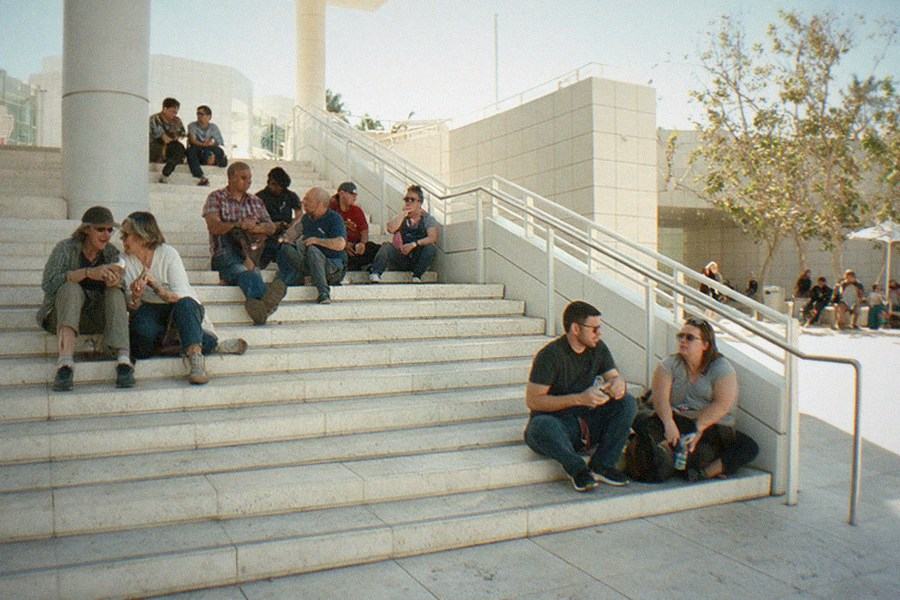
The setting reinforces the split. The Center's hilltop position means the view over the Los Angeles basin, from the ocean on clear days to the San Gabriels, is part of the visit, and the arrival by the hovertrain is a small event in itself. The Villa's position in a canyon mouth means the experience is inward-facing: you enter through a stone-walled walkway, and the outside world mostly disappears until you come back out onto Pacific Coast Highway. One museum is about looking out, the other about looking in.
The Villa is also the quieter of the two. Its daily capacity is smaller, its subject draws a narrower crowd, and its location off the main tourist routes means the galleries rarely feel crowded. The Center is a destination on most Los Angeles itineraries and can feel busy at peak hours, especially around the garden viewpoints. Neither is unpleasantly packed, but if crowd tolerance is a factor in your trip, the Villa is the gentler morning.
It is worth knowing what neither museum is. The Center is not a natural history museum and holds no dinosaurs, and the Villa is not an archaeology dig site you walk through; both are finished, curated gallery experiences. Visitors sometimes arrive at the Villa expecting ruins and find a fully reconstructed building instead, which is a different pleasure but not the one they pictured. Knowing that in advance changes which building feels like the right afternoon.
What Does A Visit Cost At Each Location?
Admission is free at both museums, the timed reservation is free at both, and the real cost at each is parking: $25 per car at either site, dropping to $15 after 3pm, with the Villa adding a $10 evening rate after 6pm for special events. There is no Los Angeles CityPASS covering either museum, and Go City Los Angeles, the real city pass, is not needed for the Getty since entry is already free.
The parking figures are verified against the Getty's own transportation guidance, which confirms the $25 daily rate and the $15 after-3pm rate at the Center's arrival plaza, as published on the museum's parking and transportation page. The Villa matches: $25 per car, $15 after 3pm, and $10 after 6pm when evening events run. That means an afternoon arrival at either site cuts the single largest cost of the visit nearly in half, which is worth building into your plans if your schedule is flexible.
| Cost item | Getty Center | Getty Villa |
|---|---|---|
| General admission | Free | Free |
| Timed reservation | Free, required | Free, required |
| Parking per car | $25, $15 after 3pm | $25, $15 after 3pm, $10 after 6pm for evening events |
| Ticketed extras | Parking only | Parking only |
| Without a car | Free | Free |
The free-entry claim deserves one qualification. Free means free general admission, and the reservation system exists to manage capacity, not to charge you. What is not free is the car, and in Los Angeles the car is how almost everyone arrives. A family of four driving in pays the same $25 as a solo traveler, which makes the per-person cost trivial, but a visitor comparing the Getty against a paid museum should still count parking as the price of the visit. Two passes in the site's research disagreed on whether Center parking was $25 or $20, and the tiebreak read the museum's own page and confirmed $25, so that is the figure this site prints.
The comparison with paid museums is worth pausing on, because it reframes the whole decision. A paid Los Angeles museum such as LACMA charges $30 general admission, or $25 for LA County residents, and the Academy Museum of Motion Pictures charges $25 at the door, so a couple visiting either Getty by car pays less in total parking than one person's ticket at a paid museum. That arithmetic is why the two Gettys anchor so many Los Angeles itineraries, and why the parking fee, small as it is, deserves the attention this site gives it.
What Are The Hours And Closed Days At Each Museum?
The Getty Center is closed on Mondays and the Getty Villa is closed on Tuesdays, so a Monday trip rules out the Center and a Tuesday trip rules out the Villa. The Villa's smaller daily capacity means its timed slots run out earlier in the day, and both museums release reservations in advance through the same booking system, so the closed day matters less than the slot you can actually book.
The closed days split the week cleanly, and they are the first thing to check when you are slotting the Gettys into a trip. A visit that begins on a Monday can only reach the Villa, and a Tuesday can only reach the Center, which is the opposite of what most people guess. Midweek arrivals have the easiest run, since Wednesday through Sunday both museums operate and the choice reverts to interest and route. Visitors planning a longer stay should simply place the Gettys on days that avoid their respective closures, and treat the closed days as a scheduling constraint rather than a reason to skip either museum.
| Museum | Closed | What it means for planning |
|---|---|---|
| Getty Center | Monday | Any day but Monday works; weekend slots book out earliest |
| Getty Villa | Tuesday | Pairs naturally with a coastal day, Tuesday excluded |
Reservation timing interacts with those closures. The Center draws the bigger crowd and its weekend slots are claimed well ahead, while the Villa's smaller capacity means fewer slots exist in the first place, even if demand is lower. Booking both museums for the same day, which the next section covers, means securing two timed entries before the trip rather than trusting same-day availability. The shared booking system makes that straightforward, but it rewards travelers who plan a week or two out.
Which Getty Should You Choose For Your Trip?
Choose the Center for a first visit to Los Angeles, for European painting, for gardens and architecture, and for the views, because it is the one that shows you the city. Choose the Villa if you have already seen the Center, if ancient history is the point of the trip, if you are pairing the museum with the coast, or if you want a shorter, calmer visit that a family can finish before lunch.
A useful way to decide is by what else is on that day of your itinerary. The Center pairs naturally with Brentwood and Westwood, with the Hammer Museum's free galleries a short drive away, and with an evening anywhere on the Westside. The Villa sits on Pacific Coast Highway, so it pairs with a beach afternoon, with Malibu, or with a slow coastal drive, and it turns the museum into one stop inside a bigger coastal day. Neither pairs well with a Downtown or Hollywood day without building in serious drive time, because they sit on opposite sides of the city's traffic patterns.
| If you want... | Pick | Why |
|---|---|---|
| Van Gogh, Monet, Rembrandt | Getty Center | The European painting collection lives here, not at the Villa |
| Ancient Rome and Greece | Getty Villa | The Villa's entire collection is the ancient Mediterranean |
| Views over the city | Getty Center | The hilltop terraces look across the whole basin |
| A garden to wander | Both | The Center's Central Garden is large, the Villa's peristyle is intimate |
| A two-hour visit | Getty Villa | One focused building, easily done in a morning |
| Architecture as the main event | Both | Meier's campus and the reconstructed villa are both landmarks |
| To combine with the beach | Getty Villa | It sits directly on Pacific Coast Highway |
Families with school-age children often get more out of the Villa than they expect, because the ancient world arrives in concrete form: a Roman house you walk through, gods and athletes on vases, and a garden that looks like a picture in a textbook. The Center is the stronger pick for teenagers with broader tastes and for adults whose interest in art is general rather than specific. Neither museum is a bad choice, and the fact that both are free removes the risk of a wrong bet: the only thing you can spend badly is the afternoon.
Repeat visitors should also weigh the rotation factor. The Center's temporary exhibitions and photography galleries change regularly, so a second visit a year later can feel substantially different, while the Villa's ancient collection is largely permanent and rewards a deeper second look rather than a new one. If your first Getty visit was years ago, the Center is more likely to show you something you have not seen; if you have never been to either, the descriptions above are the honest guide.
If your trip allows only one Getty and you are unsure, the Center is the safer pick, and this site's comparison of Getty Center costs and parking covers the practical side of that visit in detail. The Villa's entry details, including what the timed reservation actually gets you, are laid out on the Getty Villa tickets and entry page.
Can You Visit Both Getty Museums In One Day?
Yes, both museums can be done in one day, since they are about twenty miles apart, roughly forty minutes of driving without traffic, but it only works as a morning-at-the-Villa, afternoon-at-the-Center plan, because the Villa closes earlier, the Center's parking drops to $15 after 3pm, and you must hold two separate timed reservations for the same date.
The order matters more than most visitors expect. The Villa's canyon location makes it the better morning stop, before the coastal drive gets busy and while the peristyle garden is still cool. Driving inland to the Center afterward puts you on the hill for the late-afternoon light, which is when the terraces are at their best, and it lands your parking fee in the $15 window. Doing it in reverse means arriving at the Villa mid-afternoon with less time before it closes, and paying full parking price twice.
Reservations are the other constraint. Each museum issues its own timed tickets, and both release them in advance through the Getty's shared booking system, so a same-day double visit needs two bookings secured before you leave your hotel. Free timed tickets at the Gettys go the way of all free timed tickets in Los Angeles: the popular slots disappear first, and weekend slots at the Center in particular can be claimed well ahead. Book the Villa for the earliest morning slot you can manage and the Center for mid-afternoon, and the day assembles itself around those two anchors.
The double visit is genuinely rewarding, because the two museums are such different experiences that they do not blur together. A morning inside a Roman villa and an evening above the whole city is one of the better museum days Los Angeles can produce, and the total cost is one $25 parking fee at the Villa, one $15 fee at the Center after 3pm, and nothing else. If your energy or your schedule will not stretch to both, pick the one whose description above matched your trip, and save the other for a future visit, because the free admission means there is no financial penalty for splitting them across two trips.
One caution for the ambitious: the double day is a museum day, not a beach day, and trying to add a long coastal stop between the two usually collapses the plan. The drive between the museums is the natural break, and anything more elaborate than a quick lunch near the route tends to eat the afternoon slot you booked. Treat the two reservations as fixed appointments and the day works; treat them as suggestions and the second one slips away.
If the Villa is the one that fits your plans, a guided product covering the museum starts from $175 on the operator's live listing, and it is worth remembering that this is a transport-and-entry convenience, not the price of admission, which remains free.
Common Questions About The Two Getty Museums
Getty Villa Or Getty Center: Which One Should You Visit?
Most first-time visitors should choose the Getty Center for its larger collection, gardens and hilltop views, while the Getty Villa is the better pick for ancient Greek and Roman art, a quieter visit and a coastal day. Both are free with a timed reservation, so the choice is about your interests and your route, not money.
Is the Getty Villa free like the Getty Center?
Yes. General admission at the Getty Villa is free and the timed reservation is free, exactly as at the Getty Center. Parking is the paid part: $25 per car, $15 after 3pm, and $10 after 6pm for evening events.
How far apart are the Getty Villa and the Getty Center?
Roughly twenty miles, about forty minutes of driving without traffic. The Villa is on Pacific Coast Highway in Pacific Palisades, the Center is in the Sepulveda Pass above Brentwood, and the connecting route runs through canyon roads and the freeway corridor.
Which Getty has the Van Gogh?
The Getty Center. The European painting collection, including Van Gogh's Irises, is displayed at the hilltop campus. The Getty Villa holds only the ancient collection of Greek, Roman and Etruscan art.
Can you see both Getty museums in one day?
Yes, with two timed reservations. The standard plan is the Villa in the morning and the Center in the afternoon, which catches the Center's after-3pm parking rate of $15 and the best terrace light.
Is the Getty Villa open after the Palisades Fire?
Yes. The Getty Villa reopened after the January 2025 Palisades Fire and is operating normally. Older guides that describe it as closed are out of date.
Do you need a reservation for the Getty Center or the Villa?
Both require a free timed reservation, booked in advance through the Getty's shared reservation system. Popular slots, especially weekends at the Center, can be claimed well ahead, so book as early as your plans allow.
Is there a pass that covers the Getty museums?
No pass is needed, because admission at both museums is free. There is no Los Angeles CityPASS; Go City Los Angeles is the real city pass, from $94, but it would add nothing to a Getty visit.